


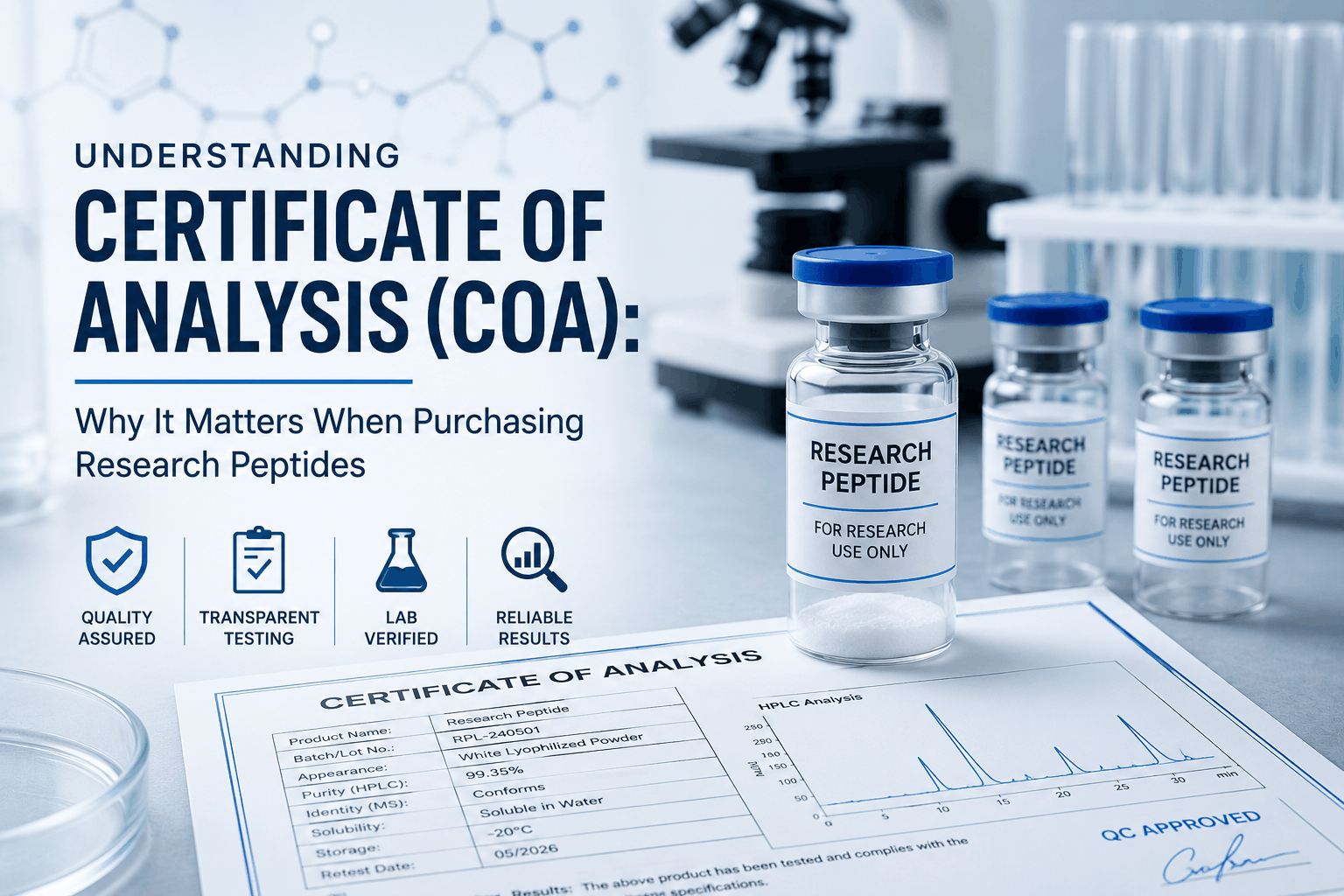
Understanding Certificate of Analysis (COA): Why It Matters When Purchasing Research Peptides
In scientific research, accuracy and consistency are essential. Every experiment depends on reliable materials, and even small variations in product quality can influence research outcomes. This is why a Certificate of Analysis (COA) is one of the most important documents researchers should review before purchasing research peptides.
Whether you’re sourcing peptides for metabolic research, longevity studies, or cellular biology, understanding what a COA contains can help ensure you’re working with materials that meet your laboratory’s quality standards.
What Is a Certificate of Analysis (COA)?
A Certificate of Analysis, commonly referred to as a COA, is a quality assurance document provided by a manufacturer or testing laboratory. It verifies that a specific batch of a research product has undergone analytical testing and meets predefined quality specifications.
Rather than relying solely on product descriptions, researchers can use the COA to review objective laboratory data about the material they are purchasing.
Each COA is generally tied to a unique batch or lot number, ensuring complete traceability.
Why Is a COA Important?
Laboratory research depends on reproducible results. If research materials vary from one batch to another, experimental outcomes may become inconsistent.
A COA helps researchers by providing documented evidence that the product has been evaluated through analytical testing.
Some of the key benefits include:
- Product transparency
- Batch traceability
- Verified purity
- Independent quality verification
- Greater confidence in laboratory materials
- Support for reproducible research
For many laboratories, reviewing the COA is a standard part of the purchasing process.
Information Typically Found on a COA
While formats may vary between manufacturers, most Certificates of Analysis include similar information.
Product Identification
The document identifies the research peptide or laboratory material being tested.
Typical details include:
- Product name
- Product code
- Batch or lot number
- Manufacturing date
- Expiration or retest date (when applicable)
This information ensures researchers receive documentation specific to the product they ordered.
Purity Results
Purity is one of the most closely reviewed values on a COA.
Analytical methods such as High-Performance Liquid Chromatography (HPLC) are commonly used to determine product purity.
Higher purity generally indicates fewer impurities within the sample, allowing researchers to minimize unwanted experimental variables.
Identity Testing
Identity testing confirms that the material being supplied matches the intended peptide.
Testing methods may include:
- Mass Spectrometry (MS)
- Amino acid sequence verification
- Molecular weight confirmation
Identity verification helps ensure the correct compound has been manufactured.
Appearance
The COA usually includes a description of the product’s physical characteristics, such as:
- White powder
- Off-white lyophilized powder
- Clear solution (where applicable)
Appearance serves as an additional quality reference.
Solubility
Some Certificates of Analysis include solubility testing, allowing researchers to understand how the material behaves during laboratory preparation.
Storage Recommendations
Proper storage helps preserve product stability.
Many COAs include guidance regarding:
- Recommended storage temperature
- Moisture protection
- Light sensitivity
- Handling precautions
Following these recommendations helps maintain product integrity throughout the research process.
Common Analytical Testing Methods
Research peptide manufacturers often rely on advanced analytical techniques to evaluate product quality.
High-Performance Liquid Chromatography (HPLC)
HPLC measures product purity by separating the different components within a sample.
Researchers commonly use HPLC chromatograms to verify purity percentages and detect impurities.
Mass Spectrometry (MS)
Mass spectrometry confirms molecular weight and verifies that the synthesized peptide matches its expected structure.
Microbial Testing
Depending on the product and manufacturer, additional testing may include microbial screening or other quality assessments designed to verify manufacturing standards.
Batch Traceability
Every reputable research supplier should maintain batch traceability.
Each product batch is assigned a unique identifier, allowing researchers to:
- Match the COA to the purchased product
- Reference documentation in future studies
- Track manufacturing records
- Maintain laboratory documentation
This level of traceability supports quality control and research consistency.
Questions to Ask Before Purchasing
Before ordering research peptides, consider asking the supplier:
- Is a Certificate of Analysis available?
- Is the COA specific to the batch being sold?
- What analytical methods were used?
- Is purity clearly documented?
- Can batch documentation be verified?
- Is customer support available for documentation requests?
A transparent supplier should be willing to provide this information.
Choosing a Supplier That Values Transparency
Reliable suppliers understand that documentation is an important part of scientific research.
Look for companies that provide:
- Easily accessible COAs
- Batch-specific documentation
- Third-party analytical testing
- Clear product specifications
- Responsive customer support
- Secure packaging and shipping
Transparency helps researchers make informed purchasing decisions while supporting reproducible laboratory work.